
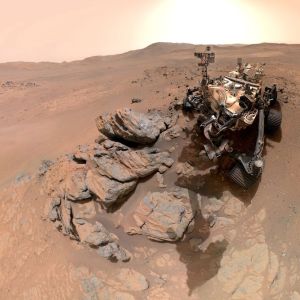
NASA’s Perseverance Rover is on a remarkable journey across Mars. Over the past five years, this six-wheeled explorer has covered 26.09 miles (41.99 km), inching closer to its goal of surpassing a marathon distance. Perseverance landed on February 18, 2021, with a mission initially set for one Martian year, which is about 687 Earth days. But the rover is in excellent shape, with enough power to last at least another decade, depending on NASA’s choices.
The rover’s main goal is to explore Jezero Crater, an area where scientists believe liquid water once existed. This crater holds clues about Mars’ wet past, making it a prime spot for studying ancient life. “Water is essential for life, and Jezero Crater has a fascinating history with water,” says Ken Farley, Perseverance’s deputy project scientist at Caltech. Historical evidence shows that more than three billion years ago, a river flowed into this area, creating a large lake.
In 2022, NASA announced Perseverance’s significant finding: reddish rocks within the crater that might indicate the presence of ancient microbial life. Although the minerals detected could suggest past life, they could also be formed through nonbiological processes. Further investigations will be conducted back on Earth to determine the true nature of these findings.
Perseverance hasn’t just focused on rock samples. It has also discovered organic molecules on Mars, showing that the environment is electrically active. For the first time, it documented an aurora on Mars, lighting up the sky in a soft green glow.
The rover is now examining ancient rocks that date back over four billion years. This time frame is crucial because it likely resembles conditions on early Earth, shortly after the planet formed. As Farley points out, “Mars can give us insights into the prebiotic chemistry that led to the origin of life.” This idea has sparked considerable interest among scientists and researchers, leading to increased discussions about life beyond our planet.
Interestingly, Mars used to have a thicker atmosphere and a warmer climate, making it capable of sustaining liquid water. Today, the planet is cold and barren, but these ancient environments inform our understanding of how life may have emerged.
Perseverance isn’t the only rover on Mars. Curiosity has been exploring since 2012, covering 22.93 miles (36.91 km) at Gale Crater. However, Perseverance is set to log more distance and gather even more data. It also brought Ingenuity, the first helicopter to fly on another planet, which has successfully conducted 72 flights in Mars’ thin atmosphere.
Experts believe the variety of environments around Jezero and beyond makes this a unique laboratory for studying the planet’s history. The ongoing discoveries from Perseverance continue to captivate researchers and enthusiasts alike, fueling excitement about the potential for past life on Mars.
As the exploration continues, scientists are hopeful that the samples collected will lead to groundbreaking discoveries. To learn more about these missions and their findings, visit NASA’s official page on Mars exploration.
Source link
NASA, Martian surface, Ken Farley, life on Mars, Perseverance, Jezero Crater, Martian atmosphere
