
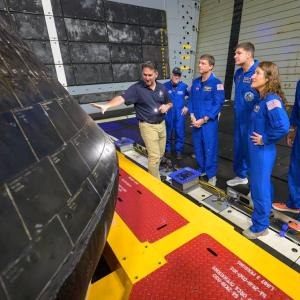
NASA recently wrapped up its Artemis II mission, which successfully transported astronauts to the moon and back. This journey, marking a significant milestone, tested the capabilities of the Orion spacecraft and the Space Launch System (SLS) rocket, preparing both for crewed missions planned for 2027 and 2028.
Initial assessments show that the Orion’s heat shield performed well, with less char loss than seen in earlier uncrewed tests. The capsule splashed down just 2.9 miles from its target, and its entry speed was impressively close to predictions. This success is a promising sign for future lunar missions.
However, not everything went smoothly. The mission faced challenges with the toilet system. Shortly after launch, astronauts encountered issues with the urine vent line. Christina Koch, one of the mission specialists, worked with ground control to troubleshoot the problem. NASA is now analyzing the data to fix this for future flights.
In the meantime, the crew shared fascinating moments from their lunar journey. Commander Reid Wiseman uploaded an amazing video showing Earth setting behind the moon, a sight rarely seen since the Apollo missions over 50 years ago.
Living in microgravity also takes a toll on astronauts’ bodies. Koch recently shared a video of herself struggling with balance exercises upon returning to Earth. In microgravity, our body’s orientation systems become less reliable. Upon returning to Earth, astronauts often rely heavily on their vision to regain balance.
In terms of public interest, Artemis II has sparked significant discussion on social media. Posts about the mission have surged, with many users eagerly sharing their excitement for humanity’s return to deep space exploration.
As NASA prepares for its next missions, it remains focused on refining spacecraft systems, ensuring that astronauts will have the tools they need for safe travels ahead. For more details, visit NASA’s official article.
Source link
NASA, Orion spacecraft, Reid Wiseman, Artemis II, Christina Koch, SLS rocket
