
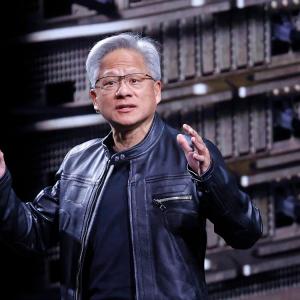
Nvidia’s CEO, Jensen Huang, is known for his enthusiastic approach. He’s not just optimistic—he usually delivers impressive results. Recently, he announced a significant opportunity for Nvidia: a potential $200 billion market tied to a new product called Vera, a CPU designed for “agentic AI.”
In a call with investors, Huang shared that Nvidia’s revenue hit a record of $81.6 billion, with projections of $91 billion for the next quarter. Vera is being pitched as a game-changer, already seeing promising sales figures.
However, there’s a cloud of uncertainty hanging over Nvidia’s future. While the company excels in GPUs, the CPU market has traditionally belonged to giants like Intel and AMD. Recently, Amazon Web Services made headlines for securing a major contract with Meta for its own AI chips, raising questions about Nvidia’s CPU ambitions.
Despite concerns, Huang insists Vera can transform the AI landscape. He believes this CPU is the first of its kind, specially built to handle tasks that AI agents will perform. The design focuses on quickly processing multiple tasks, a departure from traditional CPUs built for speed.
Huang’s optimism stems from actual sales; Nvidia has sold $20 billion in Vera CPUs this year alone. He envisions a future where AI agents outnumber human users, fueling demand for more CPUs. “We’re going to need a lot more CPUs,” he states, suggesting a strong growth trajectory ahead.
Notably, a report from McKinsey supports Huang’s vision, predicting that by 2030, AI could contribute up to $13 trillion to the global economy. This aligns with Huang’s belief in the expanding potential of AI technology and the role of new CPUs like Vera.
In this competitive landscape, Nvidia’s focus on AI continues to shape its strategies. As tech giants race to innovate, the landscape is changing, but Huang’s confidence in Nvidia’s place at the forefront remains strong. Only time will tell how these dynamics evolve.
Source link
Jensen Huang, Nvidia, VivaTech
