
By Will Dunham
May 28 (Reuters) – T. rex is a name many recognize, but few know about its marine counterpart, Tylosaurus rex. This giant predator swam in the seas around 80 million years ago, during the late Cretaceous period. Unlike the land-based T. rex, Tylosaurus rex ruled the water, showcasing its own unique features.
Scientists have confirmed Tylosaurus rex as a distinct species through detailed studies of its fossils. This creature had an impressive size, sharp teeth designed to tear through flesh, and strong muscles in its jaws and neck. All these traits made it a fierce predator of its time.
Around 66 million years ago, Tyrannosaurus rex roamed areas of Western North America. In contrast, Tylosaurus rex glided through an inland sea that split North America. With a streamlined body, a long snout filled with large teeth, and paddle-like flippers, it was well-adapted to its aquatic life.
The largest known T. rex fossil, named Sue, is housed at the Field Museum in Chicago and measures about 40.5 feet long. Tylosaurus rex, meanwhile, boasts a specimen named Bunker at the University of Kansas, measuring about 43 feet long. Bunker was originally thought to be a different species but was reassigned to Tylosaurus rex after further analysis.
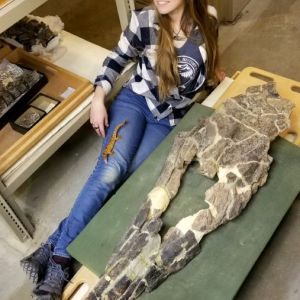
Paleontologist Amelia Zietlow from the History Museum in Appleton, Wisconsin, notes, “The skull alone is as long as I am tall—5 foot 7 inches.” This highlights just how impressive and intimidating these creatures were.
Tylosaurus is part of a group called mosasaurs, which thrived for about 30 million years of the dinosaurs’ reign. These creatures evolved from land lizards to become apex predators in the oceans. Some modern lizards, like the Komodo dragon, are seen as distant relatives of Tylosaurus rex.
Zietlow describes the awe a Komodo dragon inspires, saying, “Imagining something much bigger and more fearsome is hard.”
Ron Tykoski, a curator at the Perot Museum of Nature and Science in Dallas, compares Tylosaurus rex to today’s largest great white sharks. He points out, “Picture a marine Komodo dragon stretching 35 to 45 feet long—impressive, right?”
Most Tylosaurus rex fossils have been found in north and central Texas, with Bunker being an exception from Kansas. The holotype, or the fossil used to designate the species, is preserved at the Perot Museum.
The name Tylosaurus rex translates to “king of the tylosaurs,” parallel to the well-known Tyrannosaurus rex. While these two giants did not coexist, their similar names highlight their dominance in their respective habitats.
Tylosaurus rex was likely an expert hunter. Its strong jaws and teeth indicate it could prey on large marine reptiles and fish. Zietlow adds, “They were generalists when it came to diet, feeding on various animals.”
Both T. rex and Tylosaurus rex showcase the incredible diversity of life in the Cretaceous period, captivating our imagination today.
For more insights on paleontology and the incredible creatures of our planet’s past, check out related studies from the American Museum of Natural History.
Source link
Tyrannosaurus rex, marine reptile, Tylosaurus, Amelia Zietlow
