
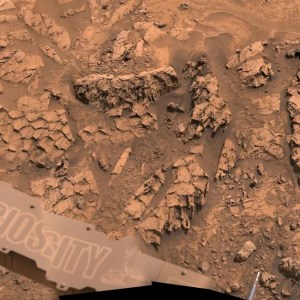
NASA’s Curiosity rover recently found rocks on Mars that look just like giant reptile scales. These unusual formations are located in a crater called Antofagasta on Mount Sharp, a prominent Martian feature.
The rover took pictures of these strange rocks as it moved toward Antofagasta, snapping images on April 7 and April 13. Kevin M. Gill, a NASA engineer known for his image processing work, shared these captivating colors online, sparking interest and speculation.
Many people online have likened these rocks to reptilian scales. Some even joked that they resemble dragons. The formations stretch across the ground for what seems like meters, catching the attention of scientists. Abigail Fraeman, a planetary scientist at NASA, noted that while rocks with similar shapes have been seen before, the abundance of these “scaly” formations is impressive.
This phenomenon isn’t entirely new. Similar polygon shapes have appeared on Mars, often linked to the drying of mud or movement of ice beneath the surface. However, scientists are still figuring out exactly how these latest formations came to be.
Curiosity has gathered several images and chemical data to help explain these textures.
Interestingly, the rover has been uncovering other peculiar geological formations. Before reaching Antofagasta, it spent months exploring what are known as “spiderwebs” on Mount Sharp. These patterns zigzag across the Martian terrain and are also notable for strange spherical stones that resemble eggs stuck on them.
Since landing on Mars in 2012, Curiosity has documented various objects that look like animals, from a coral-like structure to other shapes resembling turtles and spiders. NASA’s other rover, Perseverance, has also found animal-like features since its arrival in 2021, including what appears to be a turtle.
Most of these interpretations stem from a phenomenon called pareidolia, where our brains recognize familiar patterns in random objects.
These discoveries spark curiosity about Mars’s geologic history and whether these formations could provide clues about water’s past on the planet. Moving forward, as new images and data roll in, they will help researchers paint a clearer picture of Mars’s enigmatic surface.
For more on Mars and its geological wonders, check out this NASA article.
Source link
Antofagasta, NASA, Gale crater, reptile scales, Curiosity rover, Mars rover, Mount Sharp, scales
