
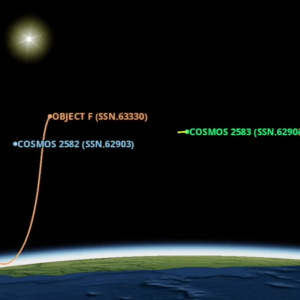
Astronomers recently observed two Russian military satellites, COSMOS 2581 and COSMOS 2583, pass incredibly close to each other, within just 3 meters (about 10 feet). This unusual maneuver took place in February 2025, while the satellites were orbiting about 585 kilometers above Earth.
The event caught the attention of COMSPOC, a space situational awareness company based in the U.S. They said this wasn’t a random occurrence. Instead, it involved precise adjustments to keep the satellites in such a tight formation. According to COMSPOC, “Whatever Russia is testing, it’s sophisticated.”
Although Russia hasn’t revealed the exact purpose of these satellites, analysts noted that one of them deployed a “sub-satellite” known as Object F. Experts believe they may be part of a program involving “inspector satellites,” designed for surveillance of other spacecraft.
Dean Sladen, an aerospace engineer at Accu Components, mentioned the impressive precision of these maneuvers. He compared them to spacecraft docking with the International Space Station, which happens regularly. However, he emphasized that these satellites completed their maneuvers without docking capabilities, making the operation riskier.
Concerns about space debris linger, especially since nearly half of the tracked objects in Earth’s orbit are junk. A collision between satellites can lead to a scenario called the Kessler Syndrome, where debris causes further collisions, creating a dangerous environment for future space missions. Given that satellites travel at speeds of around 8 kilometers per second, decisions need to be carefully calculated by onboard systems running complex algorithms.
Interestingly, social media reactions have highlighted concerns about the military implications of Russia’s satellite operations. Many users express worries that these maneuvers could indicate a growing trend of military activities in space.
As we look to the future, space safety is becoming increasingly crucial. Reports emphasize that more rigorous monitoring and diplomatic efforts may be necessary as satellite activity continues to rise.
For further insight, check out COMSPOC’s Twitter post and Accu Components’ space debris report for more on this pressing issue.
Source link
Russian satellites, space debris, Russia
