
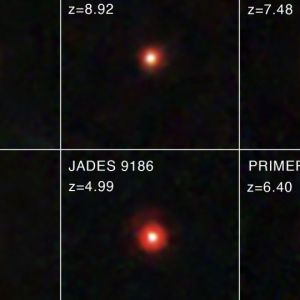
Like little cosmic puzzles, the bright red points in space, known as little red dots (LRDs), are captivating astronomers. These mysterious objects have appeared in images from the James Webb Space Telescope since it first opened its eyes to the universe four years ago. Scientists are eager to understand what they are, but the truth remains elusive.
Jennifer Greene, an astrophysicist from Princeton University, describes them as a puzzle. “It’s the first time I’ve encountered something that we just don’t understand,” she says. These dots pop up in nearly every Webb image, making them seem quite common in the vast universe.
Initially, some thought these dots might be ancient galaxies or black holes cloaked in dust. As they delved deeper, these ideas changed. Greene believes growing black holes are likely at the heart of many LRDs. Yet, she is cautious, “What we expect often turns out to be wrong, so I keep my mind open.”
In a recent study, researchers defined LRDs more clearly, coining the term in 2024. Jorryt Matthee, who led the research, found that they are especially abundant in the early universe. “Looking at distant objects means we’re seeing the past,” he explains. Even though scientists have identified around 1,000 LRDs, they are mostly located far from us, making them hard to study.
Last year, a breakthrough occurred when three LRDs were found closer to Earth. This could potentially change everything, as studying nearby objects might help reveal their nature. However, these local LRDs are extremely rare, possibly 100,000 times less frequent than their distant counterparts.
What sets LRDs apart is their color. When light from distant galaxies travels to Earth, it stretches into red wavelengths—a phenomenon called redshift. However, some scientists now suggest they might also be influenced by dense hydrogen gas surrounding them.
Anna de Graaff, a researcher at the Harvard-Smithsonian Center for Astrophysics, has been leading a project called RUBIES to map these red sources. During her team’s analysis, they discovered an unusual object they named “The Cliff.” This particular dot challenges existing theories about LRDs by suggesting it is neither a standard galaxy nor a classic black hole, but something completely new.
The Cliff possesses traits akin to a theoretical concept called quasi-stars, proposed in 2006. These are imagined to be black holes wrapped in massive clouds of gas that would glow much like a star. Mitch Begelman, who predicted quasi-stars, believes the existence of LRDs could bridge the gap between stars and supermassive black holes.
Despite the excitement, scientists are cautious about jumping to conclusions. They know that proving the existence of black holes in LRDs is tough and often based on indirect evidence. This uncertainty only adds to the allure of these cosmic anomalies.
Researchers like de Graaff see the discovery of LRDs as a pivotal moment for astrophysics, adding layers to our understanding of the universe. “They’re a surprise you hope for,” she says. The James Webb Telescope, with its hefty $10 billion price tag, indeed seems to have delivered—opening new avenues for research and curiosity in space exploration.
As we piece together the mystery of the little red dots, the search for knowledge in our universe continues.
Source link
James Webb, supermassive black holes, black holes, light wavelengths, Jorryt Matthee, strange objects, Jenny Greene
